Friday, January 31, 2014

Praying to the Sovereign God, Ephesians 1:15-23

Praying to the Sovereign God
Ephesians 1:15-23
The Series on Paul's Prayer
Message 4


Brian Lam
Fort Bend Community Church
2014.02.02
English Service


Introduction

1. We have been studying Paul's prayers in the Bible to get a deeper knowledge of God. The prayers that are biblical, persistent and effective always link us up with the nature of God. We pray with power when our prayer is aligned with who God is and what He has done.

2. Last week we had studied Paul's prayer for the Colossians. We learn how to pray for Christians we have not met personally only heard about them in the mission fields or even in the same church. We are to pray that they may be filled with the knowledge of God's will so that they walk in a manner worthy of Him.

3. This week our passage is from Ephesians 1:15-23, the first of two prayers in the Epistle to the Ephesians. These two prayers are pivotal in the letter. The first one introduces the first three chapters of the book on doctrine. The second one introduces the second half, the last three chapters, on practices.

4. Let us read together Paul's prayer for the Ephesians from 1:15-23.


5. Obviously this prayer does not stand alone. It has a context. The prayer starts with a connecting phrase: For this reason (v 15). It refers to verse 3-14, about the spiritual blessing God has sovereignly given to us, the Christians.

1) God chose us before the creation of the world to be holy and blameless (v 4)
2) In His sovereign love, He sovereignly predestined us to be adopted as His sons in accordance with His pleasure and will (v 4b-5)
3) All of this is for His glory (v 6)
4) In Christ we have redemption through His blood according to His grace (v 7-10)
5) We were chosen according to His plan who has everything works out for the purpose of His will (v 11)
6) The blessing of God also includes the wonderful gift of the Holy Spirit who is the down payment of the future hope (v 13)

All are done by God, the sovereign God. Eph 1:3-14 is the classic passage on the sovereignty of God. For this reason, Paul offers his prayer for the Ephesians. Because God is sovereign, Paul prays this prayer.

6. Let us slow down. Sovereignty is a big word. The sovereignty of God is a big concept. The sovereignty of God means that God is transcendent. He alone decides what to do according to His will. You and I are not sovereign, at least not in the same sense. I can't decide how tall I am. I have a wife. I need to listen to her. We make decisions together (I think.) But God is different. He is sovereign and He alone decides what to do.

It seems that the sovereignty of God and prayer do not mix. They are opposite ideas

We say "Prayer Changes Things."


Countless sermons have been preached, countless prayers pray under this assumption: "Prayer changes things." If prayer changes nothing, why do we pray at all, right!?

But if prayer changes things, how can we believe that God is sovereign and all knowing? How can we hold that He has His plans all worked out according to the purpose of His will (v 11)?

Read verse 4, "God chose us in Him before the foundation of the world, that we would be holy and blameless before Him." Verse 5 says, "He predestined us for adoption as sons through Jesus Christ, according to the purpose of His will."

If you believe that God "elects" or "chooses" some people for eternal life, and does not choose others, you might be tempted to conclude that there is no point praying for the lost. The elect will infallibly be saved: why bother praying for them? Right? So you have a good reason not to pray.

If on the other hand, you think that God has done all He can to save the lost, and now it is up to the individual's free will, then why do we pray to God and ask God to save them? God has done His part, there is nothing He can do now. It is up to the individual. Why pray to God? We should pray to the individual! Or just go out and preach the Gospel. Prayer to God is no use.

Either way you have reason not to pray. You can really hurt your head thinking about this sort of things.

7. Two things are very clear from the Scripture and Ephesians chapter 1 puts them side-by-side next to each other.

1) The Bible insists that we pray, urges us to pray, gives us examples of prayers. Ephesians 1:15-23 is a major prayer example from Paul. Any theology that discourages us to pray is insufficient or incomplete.
2) The Bible is also very clear on God's sovereignty. It is clearly taught in the Bible. Ephesians 1:3-14 is as strong a passage there is on God's sovereignty.


Let us start with the second statement that God is sovereign. The Bible is absolutely clear on that. Here are some passages that clearly teach that our God is sovereign.


1) When you throw a die, which side comes up is determined by God according to Proverbs 16:33 "The lot is cast into the lap, but its every decision is from the LORD."

2) "The LORD works out everything for His own ends, even the wicked for a day of disaster." Proverbs 16:4 tells us even bad things work out for God.

3) Our steps are determined by God. Proverbs 16:9 "In his heart a man plans his course, but the LORD determined his steps." You can plan your course: I am going to med school or I am going to get married next year. But it is God who determines your steps.

4) According to Jesus, if the birds are fed, it is because the Father feeds them (Matt 6:26). If the wild flowers grow, it is because God clothes the grass (Matt 6:30).

5) Psalm 135:6 "The LORD does whatever pleases Him, in the heavens and on the earth, in the seas and all their depths." God is sovereign in all the earth including the dark side. Seas and the depth of seas represent the dark side, the Sheol and death.

Therefore the Bible is very clear on God's sovereignty. He is in absolute control. No one tells Him what to do. But... but... His sovereignty never functions in the Scripture to reduce human responsibility.

Now we go back to the first statement.

8. It is our responsibility to pray, to choose, to believe, and to obey. There are countless passages where human beings are commanded to pray, to choose, to believe and to obey. And we are held accountable for our response.

Paul commands us "to pray without ceasing." Jesus taught us to pray and said "When you pray, pray like this..." Joshua challenged Israel to choose: "Choose for yourselves this day whom you will serve... but as for me and my household, we will serve the Lord" (Josh 24:14-15).

The Gospel is an invitation to believe. "That if you confess with your mouth, Jesus is Lord, and believe in your heart that God raised Him from the dead you will be saved." (Rom 10:9, 11).

But human responsibility never functions in Scripture to diminish God's sovereignty or to make God absolutely contingent.

9. Paul puts these two statements side-by-side in Ephesians chapter 1, 1:3-14 is on the sovereignty of God, then followed by one of the greatest prayers from Paul from 1:15-23. They follow one after the other because both truth are taught and exemplified in the Bible. Our problem is believing both are truth. We have a hard time to believe both. We either believe that God is sovereign and diminish human responsibility. Or we believe human responsibility over God's sovereignty.

10. But these two statements are not in contradiction. They are mystery in them, but never contradictory. It comes directly from the nature of God. The wonderful truth is that God is both transcendent and personal. He exists about and beyond time and space. From this exalted and unimaginable reach, He sovereignly rules over the world. He is sovereign.

Yet He is also personal. HE presents Himself to us not as raw power or irresistible force, but as Father and as Lord. He interacts with us, talking to us, responding to us. He listens to our prayer. Prayer does change things.

When we take pains to understand the nature of God, we will be able to do what Paul does in Ephesians 1. He states God's sovereign purpose first, and follows right after with a prayer for all of us to follow.

11. So how do we pray to the sovereign God?


Paul prays to the sovereign God for three things:

1) Because God is sovereign, we offer thanksgiving for His sovereign grace in our lives, v 15-16
2) Because God is sovereign, we pray that God's sovereign purpose may be fulfilled, v 17-19a
3) Because God is sovereign, we remind ourselves God's sovereign power, v 19b-23


I. Because God is sovereign, we offer thanksgiving for His sovereign grace in our lives, v 15-16

 
1. "For this reason, since I have heard 1) your faith in the Lord Jesus and 2) your love toward all the saints, I do not cease to give thanks for you."

2. In fact, the whole prayer (1:15-23) constitutes an extended thanksgiving. Paul thanks God for their faith in the Lord Jesus and their love for all the saints.

3. Paul ties his thanksgiving to what God has sovereignly done in them. Their faith and love, apart from God, would never happen. For this reason, referring back to God's sovereign act in salvation, expresses the cause of the thanksgiving. Without God and the work God has one as mentioned in 1:3-14, they would never have begun to display the trust, faithfulness, and love now richly displayed in their lives.

4. This is the first thing we need to learn from when we pray to the sovereign God. It is God who chose us before the foundation of the world. It is His sovereign grace that we have faith in God and have love for people. God is to be praised.

5. When we read a missionary newsletter, when we hear reports that people become Christians, we will learn to respond as Paul does. We immediately turn to God who has sovereignly intervened in their lives, and offer our praise and thanksgiving to Him.

6. When we have anything good in ourselves or happening to us, for example, my small group is growing in faith and in love, when our sons and daughters are growing in the Lord, learn to give thanks to the sovereign God. Without His sovereign grace, nothing good is possible.

7. How to pray to the sovereign God? Offer thanksgiving for His sovereign grace in our lives. Now that is the easy part. We have all learned to do it. Now come the more difficult part.


II. Because God is sovereign, we pray that God's sovereign purpose may be fulfilled, v 17-19a


1. Because God is sovereign, Paul prays that the Ephesians might know God better. Paul asks on the top of his list "that the God of our Lord Jesus Christ, the Father of glory, may give you the Spirit of wisdom and revelation so that you may know Him better" (17).

2. When we are facing difficulties in life, things we don't understand why happen to us, it is hard to accept God is sovereign. Instead of unbelief, the better way is to learn from Paul. Pray to the sovereign God that He may give us the Spirit of wisdom and revelation so that we may know Him better and know His purposes better.

3. One of the most difficult questions I am often asked is the question of why! Why did God choose the Jews to be His chosen people? Why did this young man die at such an young age without expressing faith in Jesus Christ? Does that mean he is going to hell? Why? And why does God create hell in the first place if He is all loving and kind? And the question of why can become personal. Why me? Why am I a Chinese? Why did God put me in this temptation? Why? Why? Why?

4. Instead of asking the question of why to the sovereign God, we need to pray for knowledge and understanding of His will and His purposes. The knowledge Paul is asking for is not just about doctrine or head knowledge. In the Bible, knowledge often involves practical knowledge, the ability to choose the right response. In the New Testament, Paul always refers wisdom to the understanding of God's activity in Christ and the benefits it brings to believers.

5. Therefore when we don't understand why the sovereign God is doing this or doing that, instead of questioning His goodness or doubting His sovereignty, we can ask for personal practical knowledge of His will so that His purposes may be fulfilled in us. This is very hard to do, especially when we are struggling for answers.

6. Illustration: Thirty-some years ago, I had a friend I met in college. He was handsome, musically trained, spoke Chinese and English perfectly, went to seminary after a Master degree, and served in the church as a pastor for 10 years before he returned to Hong Kong and taught in a premier Chinese seminary. Every student loved him and adored him. He had a beautiful wife and three very young children. One summer, he discovered that he had stage four liver cancer and he died after a year or so, not even 40 years old. Everybody was shocked. Everybody asked why. Why him? What was God doing? He prepared him all his life and when he was about to shine the brightest for Jesus and make a big impact for His kingdom, God took him home. Why? What was the point?

But instead of asking why to the sovereign God, he asked the question, "Why Not?" Why not me? Instead of pointing the finger toward God, he humbly bowed and listened. Instead of asking why, he tried to answer the question of who. He tried to understand who God is and what He has done for him. Today people still remember him. He still speaks. To the sovereign God, he asked for understanding of His perfect will so that God's purpose might fulfill in him.

7. In verse 18-19, Paul asks specially for a threefold enlightment:

1) He asks for knowledge of the hope God brings.
2) He asks for knowledge of the wealth of glory laid up in our inheritance.
3) He asks for knowledge of the greatness of God's power.

Because God is sovereign, the question is not why, but who God is and what He has done for us. The deeper the knowledge, the greater trust and security.

8. Job has suffered greatly. He and his three friends all ask the question of why. Why is this happening to Job? The friends conclude that it must be Job. He must have done some evil. Job disagrees but he keeps asking why? The God shows up. He did not answer the question why. Yes there is an answer to why Job suffers. It is because of Satan's accusation and God's sovereign will to test Job. There is a reason to all of these. But God does not explain it to Job. He just shows him who He is and what He has done. That is how we should pray. Pray for the knowledge of who He is and what He has done.


III. Because God is sovereign, we remind ourselves God's sovereign power, v 19b-23


1. When you think of God's sovereignty, to what does your mind turn? POWER. A sovereign nation has power over its territories. A sovereign king has power over his subjects. Because God is sovereign, He has power. Paul's prayer reminds us of God's most dramatic displays of power.

2. I confess I am inclined to think of God's power in creation. I think of God's power in each star and upholding the universe by His powerful word. But to Paul, the great and the most dramatic displays for God's power is in Jesus Christ and in the church.

3. Paul prays to remind us the power that raised Jesus from the dead, the power that exalts Christ far above all rule and authority and power and dominion and above every name that is named, not only in this age but also in the age to come. God put all things under His feet. And this power also puts Christ as head over everything for the church. All of God's sovereign power is for the good of the church. All of His sovereignty is exercised for the good of the church.

4. Not a drop of rain can fall outside of Jesus' sovereign power. All our days, our health, our illness, our joys, our victories, our tears, our prayers fall within the sovereignty of one who was crucified on my behalf. For Christians, that means God's sovereignty can no longer viewed as a theological point. It must be understood as God's love for us resulted in worship and gratitude.

5. When we see the church with all of her problems and shortcoming, we easily lose hope and are discouraged. But because God is sovereign, we need to be reminded of God's power which puts Jesus as head over everything in the church. Jesus is in control of the church. This is the prayer we need to pray all the time that we are reminded of God's sovereignty and power over the church. In the church, God has broken down the walls that divide us, Jews and Gentiles (Eph 3). In the church, God is the head and everyone is under Him (Eph 4). In the church, we are growing (Eph 5). And in the church, we are going to win the spiritual battle (Eph 6). What a dramatic power in displays in the church!


Conclusion


How do we pray to the sovereign God? We can pray Paul's prayer.

1) Because God is sovereign, we offer thanksgiving for His sovereign grace in our lives, v 15-16
2) Because God is sovereign, we pray that God's sovereign purpose may be fulfilled, v 17-19a
3) Because God is sovereign, we remind ourselves God's sovereign power, v 19b-23


Thursday, January 30, 2014

如何為未見過面的信徒祈求?西 1:9-12

如何為未見過面的信徒祈求?
歌羅西書一章九至十二節
《保羅的禱告》系列
第三講


林永健牧師
福遍中國教會
2014.01.26
粵語堂、英語堂


引言

1. 這是《保羅的禱告》系列的第三講,D. A. Carson 說:「現令西方的教會最需要的是對神更深的認識。」而認識神的一個最基本的方法是禱告,合乎聖經、持久、屬靈的禱告使我們明白神、認識神,所以這系列的講道,我們一同向保羅學習,效法他禱告的方法、禱告的態度、禱告的詞語、禱告的目的與意義、禱告的優先次序、禱告應祈求什麼…等。

2.  前兩講我們研究過帖後一章與帖前第三章保羅節禱告,今天我們讀歌羅西書一章九至十四節保羅為歌羅西教會信徒的譸告,六節的經文,一百零六個希臘字,卻只有一個句子,一個主動詞,讓我們先同聲讀第九節至十二節一次:


一、為從未見過面的信徒祈求

1. 保羅從未到過歌羅西,歌羅西的教會不是保羅所設立的,保羅在以弗所的時候,曾帶領一位叫以西弗的歌羅西人信主(參西一 7;四 12-13;使十九 1;8-10),歌羅西的教會很可能是以西弗所建立的。


2. 雖然保羅從未到過歌羅西教會,並不認識歌羅西教會的信徒,但他說:「我們自從聽見的日子,也就為你們不住的禱告祈求!」(一 9),「不住的禱告祈求」是九節至十四節唯一的主動詞,保羅為我們留下美好的榜様,為那些從未見過面的信徒但聽見他們的情況後,就不住的為他們祈求。

反觀我們的禱告,大部份的時候都是為我們認識的人禱告,我們的家人,我們的父母,兄弟姊妹,自已小組的組員,教會中的弟兄姊妹,為他們的需要在神面前祈求,這本不是錯的事,若我們不為他們祈求,誰為他們祈求呢?但我們若只為我們認識的人祈求,我們的禱告是小圈子的禱告,很容易成為自我中心的屬靈內向者(Spiritual introverts),只關心自已的事,關心你認識的人的事,我們不能做一個自我為中心的基督徒,我們要向保羅學習,擴張我禱告的領域,增加我們事奉的範圍,與神的心同為一個關心普世的心,讓我們的的禱告成為認識神的一度門。

3. 一章十二節保羅稱歌羅西的信徒為與保羅同得基業的「聖徒」,雖然並不認識,從未見面,卻是同得基業的主內弟兄姊妹,一同領受神生命的人,走向天家的同路人。


4. 保羅為歌羅西的信徒的祈求並不是單向的,保羅也請求歌羅西的信徒為他祈求,「也要為我們禱告,求神給我們開傳道的門,能以講基督的奧秘。」(四 3)雙方並不認識,卻能有禱告的團契,這是何等美的事。


5. 我們向保羅可以學習怎麽禱告?

從每週教會的週刋中,我們知道國語的會眾的消息的時候,你的反應如何?你會為國語的會眾禱告祈求嗎?又或者你說:「我根本不認識他們,又如何為他們禱告呢?」雖然是同一個教會,但彼此不認識,只是點點頭的交情而已,聽見他們上週五有一佈道的聚會,有一位從台灣來的的傳道人分享信息,你聽聞國語部去年九月起舉行一年的門徒訓練課程,在主日學的時間,所有的人一同來接受訓練,你是否願意為他們不住的祈求?因為他們是與你同得基業的弟兄姊妹!

上週三,教會有每月一次的聯合禱告會,國語、粵語、英語的弟兄姊妹都一同參加,同心合意向神祈求,我知道我們當中有人因為不認識禱告的對象而不來參加這類的聯合禱告聚會,但這正是保羅向我們示範為未曾見過面的信徒禱告,上週的禱告會,我們同心為西安的明德福音教會禱告,我們除了三、四位曾到西安短宣見過他們之外,所有的人都未曾見過明德教會的弟兄姊妹,我們的宣教士陳牧師、師母在西安服待三年多,帶來很多美好的消息,他們如何從神領受福音西傳的異象、如何喜歡讀神的話語、如何長進,令人感動,為他們感謝神,最近他們將要搬至一個新的地方聚會,期望能容納更多的人,同時可以發展兒童事工,這些都是令人興奮的消息,我們雖然未曾見過他們,但我們可以像保羅一樣,不住的為他們祈求。

當我們學習為他們祈求的時候,我感覺神的靈在我們當中,帶領我們禱告,我們衝開屬靈內向的傾向,透過禱告,深化對神的認識。

今年寒假的時候,李牧師會帶短宣隊去危地馬拉(Guatamala),幫助一些當地的孤兒,我們大部份的人都很可能沒法參加,沒有机會親自認識他們,但我們可以為他們不住的祈求,因為我們已經聽見他們的需要,這是保羅留給我們的榜樣。

6. 我們應如何為他們祈求?


二、為他們能遵行神的旨意禱告

1. 保羅只為他們求一件事,全段的禱告之中,只有一個祈求,「願你們在一切屬靈的智慧悟性上,滿心知道神的旨意。」(一 9b)

2. 什麽是「滿心知道神的旨意」?我分四方面去解釋這句話的意思:


3. 第一、我們一般對神的旨意的了解是神對我的旨意,神要我將來做什麽?我要與誰結婚?我是否應該去西岸工作?我什麽時候應該退休?退休之後我要做什麽?等等有關我將來的事。這想法不是錯的,神對我的旨意是什麽是絕對是我應關心的事,但這卻不是聖經中「神的旨意」最主要的意思。

在聖經中,神的旨意是神吩咐我們的事,重點不是想盡各様的方法去明白神的旨意,神的旨意是顯而易見的,聖經的重點是要我們去遵行神的旨意--神吩咐我們的命令!

例子:保羅説:「要常常喜樂,不住的禱告,凡事謝恩;因為這是神在基督耶穌裡向你們所定的旨意。」(帖前五 16-18),三個命令與吩咐,這就是神在基督耶穌裡向我們所定的旨意,神的旨意就是神的吩咐,重點不是要去發現,而是要去遵守。

例子:「神的旨意就是要你們成為聖潔,遠避淫行;」(帖前四 3)成為聖潔就是神的旨意,而且是聖經中神的旨意最明顯與最主要的意義,重點是去遵守。

聖經這樣的例子很多。

聖經中神的旨意主要是指神的吩咐與命令,重點是要我們去遵守,詩人說:「求你指教我遵行你的旨意,因為你是我的神。」(詩一百四十三 10)聖經不是說:「求你指教我你的旨意。」重點不是要知道神的旨意是什麽,神的旨意已經明顯地寫在聖經上,神的旨意已經非常清楚,問題是我們是否遵守。


4. 第二、「滿心知道神的旨意」的「知道」一字,原文是一名詞,中文翻為動詞,原文的意思不是單只頭腦的知識,而是包括尋求「知識」的人主動的參予,這種「知識」是包括我們參予(參 The Complete Word Study Dictionary: NT, 1922)

當保羅為歌羅西的信徒祈求的時候,他求的是他們能遵守神的命令,這是「滿心知道神的旨意」的意思!這也是我們要學習禱告的方向,祈求我們禱告的人能遵守神的命令。

5. 第三、第十至十二節,保羅用四個分詞去描寫當這祈求蒙應允的時候,歌羅西的信徒會是怎麽樣:


1)在一切善事上結果子(10);
我們得救是本乎恩,也因著信,不是靠我們的好行為,而善行卻是我們得救的結果,保羅祈求他們能遵行神的旨意,結果是能在一切的善事上結果子。

2)漸漸的多知道神(10);
這裡的知道,與上文一樣,不單是頭腦的知識,而是包括親身的經歷與體會,當我們遵行神的命令的時候,我們才是真知道神。

3)在壓力中,得力,而且是力上加力(11);
有忍耐、有喜樂、有寬容,這是遵行神旨意的表現與結果。

4)感謝神(12);
感恩是基督徒生活中最重要的表現之一,遵行天父旨意的人,必常常感謝神。

可見「滿心知道神的旨意」並不是要去知道神對我個人的旨意如何,重點是遵守神已吩咐的命令,在實際生活中表明出來的時候是多結善果、更多的認識神、生活有力、常常謝恩,這就是「滿心知道神的旨意」的意思!

6. 第四、「滿心知道神的旨意」是什麽意思?保羅用兩個等語來詮譯他的意思:「在一切屬靈的智慧悟性上」,中文翻為副詞的子句,「在一切屬靈的智慧悟性上,滿心知道神的旨意。」原文是兩個與「滿心知道神的旨意」相等的名詞,換句話說,什麽是「滿心知道神的旨意」?滿心知道神的旨意就是智慧與屬靈的悟性,聖經說的智慧與屬靈的悟性就是一心一意地遵行天父的命令,正如箴言說:「敬畏耶和華是智慧的開端!」

保羅為從未見過面歌羅西的信徒祈求,求的就是智慧與屬靈的悟性,求的就是他們能遵行天父的旨意,求的就是他們滿心知道神的旨意。

7. 當我們為從未見過面國語的會眾祈求的時候,我們應如何為他們求?我們又不清楚他們的問題,也不知道他們的難處,但我們可以向保羅學習,為他們能遵守神的旨意祈求,為他們求智慧與屬靈的悟性,為他們能滿心知道神的旨意祈求。

8. 例子:八零年代的時候,我被邀請到一個祕密的地方培訓一群內地到各地佈道的傳道人,培訓最後的一天,他們要求我為他們祈求,二十多個學生,我又不清楚他們個人的需要,我如何為他們祈求,聖靈教導我,為他們能遵行神的旨意祈求,那是畢生難忘的經歷。


三、祈求的目的是要他們對得起主

1. 保羅為他們祈求的目的是第十節的目的子句:「好叫你們行事為人對得起主,凡事蒙他喜悅。」

2. 什麽是「行事為人對得起主」?


「行事為人對得起主」在榮辱主導的文化(Shame-based culture)中,很容易被了解為不敢羞辱主的意思,就如中國的孩子為父母的榮辱努力讀書、結婚生子,要「對得起」父母養育之恩,但這不是這句經文的意思。

在西方個人主義高漲的文化中,我行我素,我只為自已的決定負責,與任何人無關,對這句經文真的難以明白!

「對得起」(worthy)一字在新約幾乎是保羅的專用字,共出現六次,除了一次之外,都是出自保羅的口,都是與神有關的:對得起主(三次)、對得起蒙的召(一次)、對得起所信的福音(一次)、對得起眾聖徒(一次),意思是將兩樣東西放在天平上相對,二者的相配的、適合的、合宜的。

「行事為人對得起主」的意思是我們的生活行為應與主相等配、二者的合宜的,是凡事蒙主喜悅的。

3. 這目的是崇高的,標準是高的,意思是什麽呢?

最近我到耶路撒冷的時候,開始明白這句話的意思,耶路撒冷的屬靈氣氛非常濃厚,幾千年來,人上耶路撒冷去朝見神,耶路撒冷每一塊石頭、每一吋土地,若能說話,都必述說神的偉大。當我走過幾千年來,猶太人上耶路撒冷朝見神的路的時候,我體會什麽是「與神相配,凡事討神喜悅」的意思,猶太人把神看得很重,一生以上耶路撒冷敬拜神為目的,一年辛苦努力把獻祭的錢存起來,上聖殿,換了聖殿的錢,買了獻祭的生口,沐浴更衣,行潔淨之禮,上聖殿奉上贖罪祭,在神的面前敬拜神,這是猶太人一生的目的,他們是神的子民,以敬拜神為人生的中心,目的是要得神的喜悅,這就是「對得起」神的意思。


這也是我們為別人禱告的最終目的,使信徒能與他們所信的神相配,凡事得祂的喜悅。


結論


如何為你未曾見過的信徒禱告?如何才能聽見他們的消息之後,就不斷地為他們祈求?

保羅為他們的祈求神,願他們滿心知道神的旨意,滿有智慧與屬靈的悟性,能遵守神的吩咐,多結果,多知道神,在困境中,滿有能力,能忍耐,常常感謝神,目的是要他們行事為人對得起主,凡事得他的喜悅。

這樣的禱告是否可以成為我們常常的禱告?特別是為宣教工塲的人代求,為那些你聽見卻不太熟識的人祈求,也可以為自已祈求,為教會的人祈求。


討論問題

1. 請分享你如何為教會其他的會眾禱告。為他們禱告有何困難?
2. 請分享你如何為宣教工場的人祈求,為他們祈求有何困難?
3. 保羅為歌羅西教會的信徒求的東西是什麽?什麽是「滿心知道神的旨意」?試舉例說明之。
4. 保羅這樣為他們祈求的目的是什麽?什麽是「對得起」主?


寫這篇講章的過程與一些的考量:
林永健

1. 曾想過講道結朿的時候,邀請一位我不認識的信徒上來,示範如何為他禱告。

2.這是一篇利用背境--保羅從未去過歌羅西,來決定應用方向的講章,以收窄應用的範圍,使應用能更精準。

3. 在一些抽象的觀念上,實際的例子非常重要,若沒有在大陸為同工祈求的例子,「滿心知道神的旨意」就會太抽象了,若沒有耶路撒冷的體會,「凡事得神的喜悅」也就太抽象了。

Thursday, January 23, 2014

新人的掙扎,羅 7:14-25

新人的掙扎
羅馬書七章十四至廿五節
門徒訓練第二季
《新造的人》第七講


林永健牧師
福遍中國教會
2014.01.19
國語堂


引言

1. 今天的題目的「新人的掙扎」,經文是羅馬書七章十四至廿五節。常常有人問我,「什麼是健康的教會?」我的回答是:「健康的教會不等於是完美的教會,也不是一間沒有問題的教會,不是沒有掙扎的教會。」同樣,什麼是健康的基督徒?健康的基督徒不是等於完美的基督徒,不是沒有問題的基督徒,更不是不犯罪沒有掙扎的基督徒!

我們基督徒是新造的人,憑恩、藉信、在行為之外、靠著耶穌被神稱為義的人,我們有重生的生命,是神的生命,可以與神來往,福音是神與人和好的消息,我們在基督裡與神和好,從今可以與聖潔的神來往。

這一次去以色列耶路撒冷朝聖,我體會我們能與神來往的福份,耶路撒冷被稱為「和平之城」(The City of Peace),幾千年來,人往耶路撒冷尋找平安,與神和好的平安,但外邦人被排在聖殿之外,只可以進入外邦人的院子,婦女與小孩被排在外院之中,只有猶太人的男子,經過潔淨的禮儀,帶著贖罪的祭生畜,為自己獻上贖罪祭才能與神和好,上耶和華的山,與神來往,詩人說:「在耶和華的院宇住一日,勝過在別處住千日;寧可在我神殿中看門,不願住在惡人的帳棚裡。」(詩八十四 10)。

與神和好是新造的人因信稱義的人,有神新的生命的人之特權。

但這新造的人並不是完全的人,不是沒有掙扎的人,不是不再犯罪的人。

2. 羅馬書七章講的就是新造的人之掙扎。

第七章七至十三節,是新人與律法的關係,保羅說,新造的人犯罪跌倒,不是因為律法的問題,我們常以為若沒有律法就沒有罪,若沒有時速的限制,就不會有超速的罰單,但新人的掙扎不是因為律法的原因,律法是好的,把神聖潔的本性告訴我們,我們有所不能行是因為「我是屬乎肉體的,是已經賣給罪了。」(羅七 14b)


一、新人仍是屬乎肉體的,七 14

1.  「屬乎肉體」(of the flesh)形容詞,形容「我」--新造的人的本質:肉體是代表我們屬地的存在,是亞當的後裔,由塵土而來,是過渡的,是短暫的,本質是非常軟弱,沒能力去做好,而且因亞當罪進入了世界,肉體裡有背叛神的本質,稱為罪性,代表不義的傾向,受這世界的風氣影響,自我為中心,是屬世的本質。
 
2. 保羅更用一個完成時態的分詞(perfect passive participle)來形容「屬乎肉體」我的情況,我是「賣給」罪了,「屬乎肉體」的我,本質是有犯罪的基因,有不義的傾向,這是新人掙扎犯罪的原因。

3. 我是屬乎肉體的,這事實維持不變,直至我們離世的日子,每一個基督徒都是一樣,沒有分別,希特勒與德蘭修女一樣敗壞,但這不等於新人不能真正的改變,這也不是消極無奈、認命的想法,我是屬乎肉體的,只是坦白的承認我的本質是屬乎肉體,是習慣了犯罪,信徒必須要知道自己的本質,才能知道如何去應付。

有些基督徒對牧師的期望很高,以為牧師不會犯罪,認為屬靈的人不會犯罪,這是錯誤的想法,信徒包括牧師在內,都是屬乎肉體的,本質是賣給罪,是屬地的存在,由亞當來的罪性,若不體貼聖靈而行,都會體貼肉體,犯罪離開神。

3. 這是新造的人之掙扎第一個的事實。


二、新人心中有兩個律在不停地爭戰,七 15-24

1. 第二個事實是記載在十五節至廿三節,共分三段,同一個主題重複了三次:
  • 十五至十七節
  • 十八至廿節
  • 廿一至廿三節
  

2. 「我所願意的,我並不做;我所恨惡的,我倒去做!」(七15;19)重複了兩次,可見事情的嚴重,信主之後,我們成了新造的人,新的生命是神的生命,願意做神喜歡的事,這是新人的特徵之一,但因為我們是屬乎肉體的,在本質上有犯罪的傾向,若沒有聖靈的能力,結果是「我並不做」,而「我所恨惡的,我倒去做!」因為我們習慣性的本體,自然做神不喜悅的事。


3. 保羅説:「立志行善由得我,行出來卻由不得我!」這豈不是每一個基督徒的經歷嗎?!在我們裡頭的罪性,若沒有聖靈的能力,是沒法做好的。


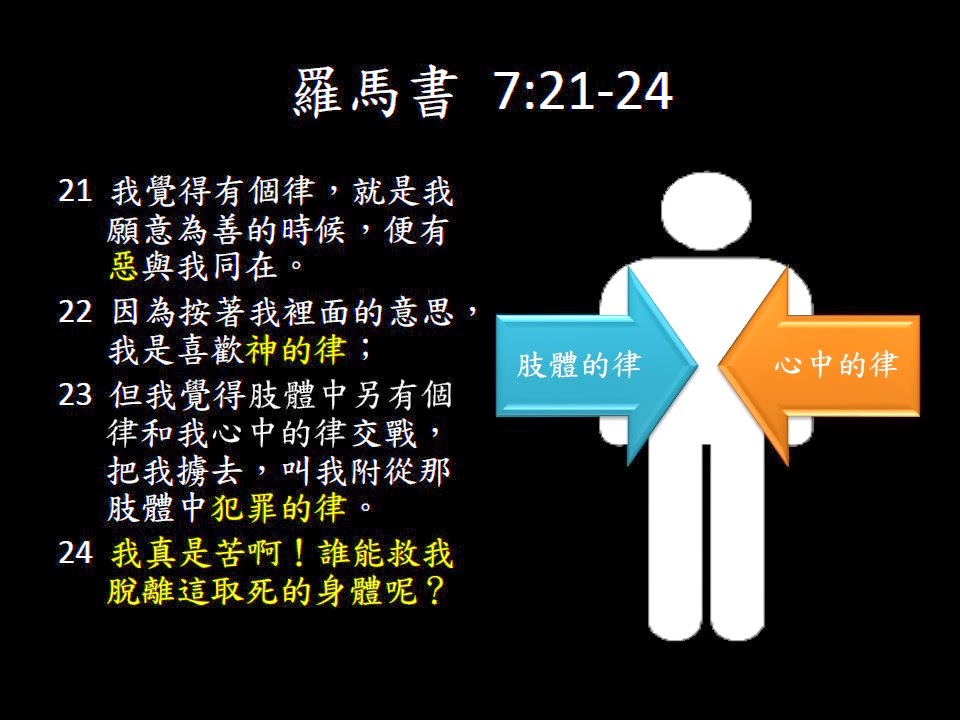
4. 21-23節形容在我們裡頭有兩個律在不停的爭戰,肢體的律與神的律在爭戰,這是一場內在的爭戰(the war within),必須要在裡面才能得勝,在這兩個律的爭戰中,保羅的結論是:「我真是苦啊!誰能救我脫離這取死的身體呢?」(七 24)

5. 現代著名的神學家 Dallas Willard 是這樣詳細地解釋體貼肉體的過程:

1)身體(Body):是我們一切行動的中心,與物質世界交往及一切人際關係的中心,由人的思想與價值觀所限制,俱自生自發的能力,又是靈命塑造主要的範疇,我們的身體受成長的環境所影響,受世界的薰陶,會不假思想地聽從身體去行惡,是為肢體中的惡發動, 但身體的習慣是可以被轉化的。

當我們體貼肉體的時候,是由身體的私慾所引動的。

2)靈魂(Soul):又可稱為「人」(Person),是人的所有向度彼此連繫起來,組成一個生命操作的系統,像今天電腦的操作系統一樣,主導控制我們的身體與行為。詩人説:「我的靈魂啊!你為何憂悶?為何在我裡面不安?」(詩四二5),我們的靈魂受肉體與罪性的影響而有所憂悶,帶動我們的身體而下沉。

3)心思(Mind):包括我們的自我形象,概念、判斷、推理與思考,而我們的意識穿梭於過去、現在與將來,藉著理性、想像與藝術,探索宇宙的奧秘,尋求人生的意義。而神的啓示是透過思想的方式賜給我們的,所以屬靈生命的成長也是從心思開始。

體貼肉體是由身體帶動,成為我們靈魂的一部份,然後改變我們的心思意念,是從下面而來的。

4 )心靈(spirit):心靈的人決擇、選擇、意志運用的地方,可以成為行善的力量,也可以成為行惡的力量。

5)神(God):體貼肉體從身體帶動靈魂,改變心思,而作錯誤的選擇,體貼肉體的就是死,與神不相同。


6. 我最近心中兩個律爭戰的例子,我雖然剛從聖地朝聖回來,剛踏過耶穌當年走過的地方,心中有很大的觸動,但當太太向我生氣的時候,我裡頭的肉體仍然作怪,發動怒氣、報復、對抗的心,這是從我裡頭的惡而來,要我行惡,是我身體自然反應的一部份,若我順從肉體,我願意做的,我卻不去做,我不願意的,我反倒去行,結果是死亡,但我心中還有一個律,是生命的律,在我裡頭要我順服聖靈,不随從肉體,這是我經常有的掙扎。


三、順服神就是生命平安,七 25

1. 第三個事實是在基督裡得勝的事實,保羅沒有就此放棄認命,他最後宣告:「感謝神,靠著我們的主耶穌基督就能脫離了。」(七 25)


2. 順從聖靈,不體貼肉體,就是在基督裡得勝的祕訣。順從聖靈,是從上而下,是神主動的,帶動異象與願意行善的心,明白神的啟示與真理,改變心思與意念,價格觀與自我的形象,從思想控制靈魂的操作系統,帶動行為上的改變。


3. 順服聖靈的生活例子:聖靈的感動是溫柔的,對抗肉體對金錢、對性、對權力的掙扎。


結論

新人的掙扎羅馬書第七章告訴我們三件事實:1)我是屬乎肉體的;2)我的裡頭有兩個律在爭戰;3)順著聖靈而行,就是生命平安。


討論問題

1. 請解釋什麼是屬乎肉體?保羅是説基督徒嗎?還是説非基督徒(七 14)?
2. 你可以根據 Willard 的解釋,重述體貼肉體的過程嗎?
3. 請你舉自己的經歷為例,説明心中兩個律的爭戰。
4. 順著聖靈而行的過程是如何?
5. 如何在生活中順著聖靈行事?請舉例説明。


回應詩歌


寫這篇講章的過程與一些的考量:
林永健

1.


Thursday, December 19, 2013

稱義的生命,羅 3:21-26; 西 1:15-20

稱義的生命
羅馬書三章廿一至廿六節、歌羅西書一章十五至廿節
門徒訓練第二季
《新造的人》第三講


林永健牧師
福遍中國教會
2013.12.15
國語堂


引言

上一週,我們討論重生的生命,那是我們熟識卻是我們信仰中最重要的觀念之一,今天我們要討論的也是我們熟識又是我們信仰中最核心的真理,「稱義」。

稱義英文是 Justification, 用作名詞是指罪人被稱為義這一件事,用作動詞是指神稱罪中為義的行動,主詞永遠是神,受詞是我們這一群罪人。

今天我們主要解答兩個問題:1)什麼是稱義?2)如何活出稱義的生命?

首先,我們同心禱告,求神的幫助!


一、什麼是稱義?羅 3:21-26

1. 什麼是稱義?


2. 福音是基督教信仰的核心,是人類的好消息,兩年前我們研讀羅馬書的時候,曾經仔細的讀過羅馬書三章廿一至廿六節,「唯獨恩典、唯獨信心、唯獨耶穌」,六節的經文把福音完整的道出,讓我們再仔細的讀一遍。


經文説:世人都犯了罪,福音是罪人的好消息,福音的好消息包括兩部份:

1)神寬容接納饒恕罪人;
2)神將耶穌的義算在我們相信接受的人之賬上。

神不單只饒恕我們,更將基督的義成為我們的義,神稱我們為義就像我們從未犯罪一樣,同樣神稱我們為義就好像我們從開始就順服一樣!(Justified as if I have never sinned; Justified as if I have always obeyed.)這就是稱義的奇妙!


3. 就如神把我們一生所做的事、説的話、想的意念與動机都記錄下來,我們一生要結賬的時候,每一個都是負債,世人都犯了罪,都虧了!聖潔的主耶穌,一生並沒有犯罪也不知罪,神不單只看在耶穌的份上,把我們負的債塗去,我們不再虧欠,神更把耶穌的賬算在我們的賬上,我們成為義人,豐富的人!

有幾次上餐館的時候,付錢的時候,發現有會友替我付了賬,有一次,有人替我們付了賬,我們沒有欠餐館的錢,他更替我們買了外賣讓我們帶回家有東西吃!

我們被稱為義是神的工作,神因為基督的死饒恕罪人,神接納我們不是因為我們的成功,人不能靠自己的功夫去賺取神的喜悦,也不能因為我們的失敗而失去神的寬容接納與饒恕!我們在神前的地位不是靠我們的順服,而是因為耶穌的順服。

4. 這是改教的時候主要更改天主教的教義,神學家用四句精采的話總結「因信稱義」的真理:
  • 唯獨信心
  • 唯獨恩典
  • 唯獨聖經
  • 唯獨基督  
兩年前我們曾經解釋過這四句話的意義,我也從羅馬書三章廿一至廿六節中以一句話總結福音的意義:

憑恩、藉信、在行為之外,單靠耶穌稱義!


5. 這就是福音!神稱罪人為義,這就是好消息!不是我們要做什麼,而是耶穌為罪人做了什麼,這才是福音,福音就是好消息!這是事實要去宣告(indicative statement to proclaim),不是命令要去遵守(not an imperative command to obey),這才是真正的好消息!

每日要禱告五次,不吃大肉,做飯要先念經文,要努力遵守幾千條清規,不能看電視,不准養狗,不准與女生握手,不准聽音樂,不准照相,男的不准戴金戴銀等等,這才能上天堂,請問這是什麼好消息?想起就頭痛。

佛教説不能殺生,不能吃肉,要修橋補路,在六道輪回中打轉,一生要努力做好,才能上天道,不然來世做畜生,甚至做餓鬼,下地獄,這是什麼福音?想起就頭痛!

6. 稱義是福音的核心,是神的工作,神饒恕罪人,把耶穌的義算為我們的義,這是神的恩典。「因信義」常常被人誤解,以為信心是使我們稱義的原因,這並不是因信稱義的意思,信心不是稱義的起因,而是稱義必需有的條件,人必需要憑信心接受神的恩典,信心不是使我們得救的好行為,我們邀請人信耶穌,是對的,人必需要接受,相信神,真心的相信,行出來的信心,不單只是認信,憑這樣的信心去接受神的救恩,在行為以外,靠耶穌稱義!

馬丁路德曾説:「我們是罪人,同時也是義人。」(Sinner and righteous at the same time),就算我們完全不義,神卻以耶穌的義算為我們的義,稱義使我們好像沒有犯過罪一樣,同樣,稱義使我們好像一直順服一樣,這是神稱我們為義的意思。

7. 稱義的道理是與世上靠己的系統與文化相反,甚至是直接衝突,使世人憤怒的事。我們從小不論是讀書還是父母的教育,都是要我們努力,愈努力愈成功,分數愈高,上更好的學校,擠進上流的社會,一位同學曾經告訴我,他出國的時候,申請了十一間研究所,最希望去史丹佛大學讀書,分數差了一點,進不了史丹佛大學,而來到了萊斯大學,心中不是很高興,能進去萊斯大學是他努力的成果,這是我們樂意與習慣的做事方法,一切以「我」為開始,在「我」的掌握之中,如果一個成績不如你,聰明不如你,卻是靠關係進入了史丹佛大學,你一定覺得不公平,很生氣!

身體的健壯不是天生的,而是天天鍛鍊而來的!若一個人不用努力,就全身都是肌肉,你一定覺得沒有公理!

「稱義」就是如此令人反胃,使人憤怒的做法!神稱罪人為義,我們是罪人也是義人,不靠自己,憑恩、藉信、在人的行為之外稱義,神寬容接納饒恕我們這樣罪人(Just as we are.)

8. 十六世紀羅馬天主教庭因為改教的事情,開了一連串的會議,作自我反醒,回應更正教帶來的問題,稱為特倫托會議(The Council of Trent, 1546-1547),會議決定停止出售贖罪卷,但宣告「因信稱義」為異端,認為稱義的義是我們的義(Inherent righteousness),神饒恕我們的罪,因為耶穌的代贖,而我們的好行為成為我們稱義的原因之一,耶穌的救贖再加上我們的行為,這樣的説法才合人的道理,正如唐三藏、孫悟空、豬八戒、沙僧去西方取經,付上極大的努力與代價,最終修成正果一樣,這是我們喜歡聽的故事!

耶穌還是不夠,加上我的努力才成!但這不是耶穌基督的福音,羅馬書告訴我們,神的義在律法之外顯明,我們是憑恩、藉信、在人的努力與行為之外,單靠耶穌被神稱為義!


二、如何活出稱義的生活?西 1:15-20

1. 耶穌的福音是給一切相信的人,我們因信而稱義,靠耶穌成為神的兒女,但我們很容易在信主之後,卻靠自己的努力與表現去過基督徒的生活。我們對稱義最大的的問題不是信耶穌成為基督徒的時候,那時我們相信「憑恩、藉信、在行為之外、靠耶穌」被稱為義,問題是信了主之後,福音就失去了意義,天天「憑自己的努力、藉自己的行為、在恩典之外,靠自己」稱義,要得神的喜悅!我們靠耶穌得生,卻靠自己生活,好像耶穌突然之間不行了,失去了功效一樣。

2. 魯益師(C. S. Lewis)的名著「地獄來鴻」中,地獄的鬼王寫信給牠的小鬼,教導牠們如何對付基督徒,很簡單:使基督徒相信基督的工作不夠,還要加上其他東西才成(Christianity AND... ),那基督徒一定不會長進!

基督加上努力追求的成功!
基督加上努力追求的名譽!
基督加上努力追求的婚姻!
基督加上努力追求兒女旳成功!

魯益師的經典作品 Mere Christianity 中文譒為「返璞歸真」,沒有把書名的意思譒清楚,魯益師指的是基督教信仰最核心的部分,我們若把信仰次要或無關重要的部分去掉,剩下的只有耶穌,但人卻喜歡在耶穌之外加上許多的東西,耶穌不夠,我們要加上自己的努力,追求美好的人生,美好的人際關係,美滿的家庭,人生夢,美國夢,中國夢,這些都是我們努力的成果,耶穌的義不夠,我們要加上我們的義。這樣,我們會覺得安全一點,與我們一般做事的方法一樣。

3. 中古世紀曾經有一段時間,藝術家喜歡把自己畫進耶穌釘十字架的圖畫之中,以下是最近的一幅名畫,我猜想是願意與基督同釘十字架的意思,但從另一角度去解讀,我們也很喜歡在耶穌完成了的救恩也加上了我們的一份。


4. 我們若活不出因信稱義的生活,教會很容易就會產生教條主義、功德主義、與道德主義,這些都是靠自己的行為稱義的主義,自己做了多少,看看別人又做了多少,自己做得多,就容易驕傲,別人做得不如你,就很容易批評自以為義,福音就不是福音了。

A. W. Pink 説:「我們最大的錯誤是要從自己的身上找到只有耶穌才能給的東西。(The greatest mistake made by people is hoping to discover in themselves that is to be found in Christ alone.)」

我們很容易離開基督愈來愈遠,不是愈走愈近,不理會他,不順服他,這自救的方法,靠自己的力量去滿足自己做好人的需要,自義使我們感覺很好,好行為如讀經、禱告、靈修、善行並不是不好,但若要靠這些來得神的喜悅,賺取神的恩典,這樣就把神的恩典當癈物,將基督變為有限的一張通往天堂的車票,信了主之後,放在口袋,死的時候才拿出來用,或把耶穌當為天國的橋,走過去之後,進入天國之後,就不用了,把橋收起了。

今天的講台,包括我在內,常常傳遞的是「努力做這個,努做那個」,對,天國是努力的人才能進去的,但在命令之先,必需先有事實,(Indicative before imperative),先明白接受了解耶穌為我們做的一切,靠祂來完成我們的救恩,成為我們的義,在成聖的過程之中,成為我們更新的力量。

5. 錯誤的福音帶來的是自義,埋怨,與失望,把我們帶進了無限的痛苦之中。稱義的真理是需要活出來的,憑恩、藉信、在行為之外,靠耶穌來被神稱為義,新的生命是從神來的生命,新生命就有新的生活,不是靠自己的力量去做好事。

例子:
一位非常愛主的弟兄,是個完美主義者,對自己的要求很高,給自己很大的壓力,對別人的要求也很高,妻子的壓力特別大,妻子已經是一位賢妻良母,對內對外都很優秀,但丈夫還是有很多不滿,時常生氣,發脾氣,每次生氣之後都很後悔,基督徒不應該這樣的,道歉自疚,自卑感很強,基督徒的生活是很苦的。

我問他:「怎麼辦?」他説:「我努力控制自己,不要生氣發怒,多安靜,多禱告。」

我真的很想説:「祝你好運!」我知道,他知道,你也知道,這是做不到的!我認為我們首先要知道,我們是罪人同時也是義人,我們是神已經接納,已經寬容,已經稱為義的人,神稱我們為義,正如我們沒有犯過罪一樣,神稱我們為義正如我們一直都是順服的人,不是因為我們的好行為,所以我們要以基督的義成為我們的義,稱義是憑恩、藉信、靠耶穌,成聖也是憑神的恩典、藉著信心,靠耶穌得生,不是靠自己的修行。

6. 再説清楚一點,信仰的核心是耶穌與耶穌的工作,好消息是因為耶穌為我們代贖,神稱罪人為義,把耶穌的義算在我們的身上,從神來的新生命,自然有新的生活,生活的改變是因為生命改變了,重生了,生命的改變是因為我們靠基督成為了義人,是生命的流露,是我們感恩的結果,我們是否應努力「做成得救的工夫」?當然需要努力,但這種努力不是生命改變的起因,而是生命改變必需要的條件之一,福音的焦點不是放在我們做了些什麼,而是基督做了些什麼,我們應更多注意耶穌與耶穌裡面的豐盛,特別是我們這一群習慣靠自己的知識份子,在命令之先是耶穌救贖的事實。

7. 當年歌羅西的教會有好些假師傅,傳揚在基督以外更好的福音,更深的道理,在耶穌之外有更大的能力,今天我們的情況也是一樣,我們很容易傳靠自己的福音。

保羅寫信給他們,第一至二章講的是「事實」(Indicative),第三至第四章才是「命令」(Imperative),首先是神為我們做了些什麼,才是我們應該去做什麼,好行為不是不好,我們卻需要明白一點:任何努力與好行為都不能使神多愛我們一些,或任何失敗也不能使神少愛我們一點,神在基督裡已經接納我們,把祂的生命給了我們,這生命是一切生命改變的起因。這才是福音。我們的罪雖然深,但神的恩典更大,我們的努力雖然重要,但改變不了我們的生命,只有耶穌才能把神一切的豐盛給我們,生命的改變離不開耶穌的義。

8. 歌羅西書一章十五至廿節


耶穌是一切首生的,最重要的,萬有是靠他造的、藉著他做的,又是為他造的,萬有是靠他而立,我們屬靈的生命是靠他造的,藉他做的,又是靠他而立的,基督徒的生活若不是靠著耶穌如何能成立?如何才有生命的改變?如何才能勝過罪惡?

9. John Piper 曾說:「我所知道最好勝過罪惡的方法是因為被神的豐盛滿足而失去對罪的興趣。」(Desiring God)

當我們被耶穌與他所成就的一切滿足,我們就有能力去過豐盛的生活,因為基督的義成了我們的義,我們靠他得生,也靠他而活。

我們不發脾氣,不是因為我們修身自律好,這樣話,只有有能力的人才能做到一點點,我們能改變是因為基督重生了我,我有新的生命,是基督的義為起因,我的努力是配合必有的條件而已。

10. 人生很多的癮(addictions)是因為人沒有讓神來填滿他們心中空虛的洞,要改變是很難的事,除非你以基督為你的義,讓他成為你的滿足與倚靠,你才能從人生的捆綁被釋放。

要打麻將的捆綁、追求別人讚賞的捆綁、追求成功的捆綁,被釋放,必需要以基督的義為你的滿足才能經歷自由。

林語堂的一句名言:「基督就像太陽一樣,而我的光只是一根的蠟燭,與太陽根本無法相比,當太陽出現的時候,我的光就不再需要了。」我們應多注目在耶穌的身上,不是我們做了些什麼,而是他為我們做了什麼,多講基督的恩典,多講生命,多從他的身上得我們努力也不能賺取的豐盛生命。

耶穌就夠了,這是福音!十字架上「成了」,這是福音,路德說:「請每日向我傳講這福音。」稱義不只是真理,而是要活出來旳生命。


結論

我極需要這福音的好消息,信主五十多年,很多時候都是靠自己去賺取神的喜悅,用事奉來証明我的價值,十年在福遍教會每天努力做好,最後筋疲力盡,還是做得不好,教會的問題還是很多,同工之間還是很多的衝突,結果我跨了,當我注重我能神做什麼的時候,神提醒我,是神為我做了些什麼;當我自疚失敗感很強的時候,神告訴我,神的義是我的義,基督為我成就我所不能做的事;當我靠自己的時候,神告訴我這是祂的教會,這是祂的工作,這是祂的責任,來倚靠祂才是真正合理的事奉,我明白之後,整個人都放鬆了,我開始學習不那麼看自己,我繼續努力事奉,但我的努力不再是那麼重要,在耶穌的光中,我的光變得微不足道,我的生命有了很大的改變,每天我要細聽耶穌的福音:憑恩、藉信接受、在我的行為之外,單靠耶穌我被神稱為義了。活出稱義的真理,生命才能真正的改變。


討論問題

1. 什麼是稱義?請你細述稱義的意思。
2. 「憑恩」是什麼意思?「藉信」是什麼意思?「在行為之外」稱義是什麼意思?「靠耶穌」稱義又是什麼意思?福音是什麼意思?
3. 因信稱義與我們靠己的文化有何衝突?請你舉例説明之。
4. 活出稱義的生命是什麼意思?如何在每日的生活中活出稱義的生命?
5. 好行為與稱義有何關係?與基督徒的成聖生活有何關係?起因是是什?必要的條件又是什麼?
6. 請分享你對這信息最大的感受。


回應詩歌


寫這篇講章的過程與一些的考量:
林永健

1. 稱義是我們信仰中最基本的道理,馬丁路德因為因信稱義的教義而與天主教決裂,更正教從此而生,在知識份子的基督徒中,靠自己的文化根深蒂故,明白因信稱義的道理不難,活出來卻不容易,我很想把這真理説得清楚,但發現不容易,與成功神學只有一線之差,神在基督裡已經成就一切,一切美好的恩典已經豐豐富富在耶穌裡,我們需要把信心去接受,聽起來與 Joe Osteen 的講法一樣,另一方面,習慣努力爭取向上的人,又如何靠耶穌去改變生命?這些都是差之毫釐謬之千哩,講道的時候,一直禱告,自覺咄口笨舌,表達能力差,很需要神的憐憫與幫助。

2. 救恩的神的救贖,人的責任在那裡?生命的改變是聖靈的工作,人的責任又在那裡?真理需要平衡,人的責任應是下一篇信息而回答的課題。


Thursday, December 12, 2013

Though the Mountain May be Removed, Isaiah 54:1-17

Though the Mountain May be Removed
Isaiah 54:1-17


By Pastor Brian
Fort Bend Community Church
ENCOUNTER Service
2013.12.01


Introduction

1. Isaiah 54:10 is one of the all time favorite of mine in the Bible. "For the mountains may be removed and the hills may shake, But My loving kindness will not be removed from you, And My covenant of peace will not be shaken," Says the LORD who has compassion on you."


Mountains and hills are immovable objects. They are huge. But God has promised us that though the mountains may be removed from here to there, the hills may shake back and forth, my love for you will not be removed from you. And my covenant of peace will not be shaken. It is God's love song to us. Like a lover, God has promised us that He will not desert us nor leave us. This precious promise is the life-safer to us when we are lonely and disappointed in life.

2. It is written in beautiful Hebrew poetry. "The mountains" and "the hills" are parallel; "may be moved" and "may shake" are synonyms; "my loving kindness" and "my covenant of peace" are two God's greatest gifts; and "will not be removed" and "will not be shaken" are the repeating verbs from the first two lines.


What does this promise mean? How does this promise relate to us?

3. When I was a little kid, I learned this verse in a children song in Chinese. The song forever sticks to my mind. But there is a slight different in the children song when it is compared to the Bible. The song says "For the mountains may be removed, and the hills may shake. But my love for you never departs from you." The word, NEVER, does not appear in Isaiah 54:10 in the Bible.

"Never depart" means "never," never now, never in the past, and never in the future. But Isaiah 54:10 says, "My love will not depart from you." It is in the future tense, from now and never again in the future.

In fact, in the preceding verses, God said, "For a brief moment I deserted you," (v. 7) and "In overflowing anger for a moment I hid my face from you" (v. 8). It did happen before. God admits that "I deserted you in the past for a moment. I did get angry with you. I did hid my face from. But from now on, I vow not to do it again. My love will not depart you" (v. 10). The promise of lasting love is for the people of God in suffering.

4. I don't know whether you have the experience of being abandoned before? How would you feel if you are deserted, left along, and abandoned? The need of safety is a human basic need. We all need protection and a sense of connection. The fear of abandonment is stressful and potentially devastating.

Kids need the protection and connectedness from their parents. Seniors are afraid of being left behind by their lifelong partner. What am I going to do if my spouse is gone before me? Many people suffer from some forms of abandonment issues, whether it is something they recognize or not. The insecurity associated with a fear of abandonment can ruin relationships, create distance between people and prevent an individual from living a normal life. 

5. The word, "abandon," is used here in Isaiah 54 twice. In verses 6 and 7, it is used to describe an abandoned wife. The husband is not coming back. He once was the closest and the most intimate one on the face of the earth. But now he is gone. He turns his face. He looks at you like a stranger. That is abandonment.

The prophet Zechariah uses the word to describe the flock deserted by their shepherd (Zech 11:17). The sheep without a shepherd is doomed to wandering without protection and guidance. The shepherd once was the care giver, leading them to still waters and quiet green pasture. But he has deserted the flock. That is the picture of abandonment. 

6. Have you experienced abandonment before?

When I was young, I was pretty "active" and "bad," always fought with my 4 siblings. Five boys with mostly 1.5 years apart. When I was eight years old, my parents decided to send me to boarding school in a nearby city, Macau. I was staying with the principal who was in charge of discipline. So I was not just sent to the principal office. I was living in the principal's home 24 hours a day, 7 days a week, for a whole year. I had a very strong sense of being deserted, being abandoned by my parents. I don't think that it was my parents' intention to abandon me. They just wanted me to get a good education, learn discipline and to be a good boy. But I felt bad. Why me? It was my fault that I came here. I missed home. I missed my parents. I missed my brothers. 

This was exactly how the Jews in captivity felt. Their nation was destroyed. Jerusalem was in ruin. They were in exile, thousands of miles away from home. They felt they were abandoned by God. But they also knew that it was their faults. God had warned them repeatedly of their idolatry and the consequences of their sins. But they did not listen. Now they were in captivity. They knew that they were deserted because of their sins.

Isaiah 40 to 55 is God's comforting words to His suffering people in Babylon. Isaiah 54:10, "For the mountains may be removed and the hills may shake, But My loving kindness will not be removed from you, And My covenant of peace will not be shaken," Says the LORD who has compassion on you," is God's promise to His deserted people. It is God's promise to those who are going through the life of storms. If you are going through hard time, feeling that God has abandoned you, this passage is written for you.


7. This storm is no ordinary storm. It is the result of your sins against God. God has deserted you and turned His face away from you. There is no one to blame for your pains and suffering, but yourself.

Adam and Eve felt it. It was their willful disobedience that they were cast out of the Garden of Eden. The feeling of rejection and abandonment must be terrible.

Jacob had to leave home because he had lied to his father and his brother. When he left home, he was alone, deserted, and he never saw his parents again. How would he feel? It was nobody's fault but his.

When Naomi left her home in Bethlehem, she had a husband and two sons. After ten years in Moab, she returned to Bethlehem alone. Her husband and two sons all died in Moab. She said "Do not call me Naomi (sweet); call me Mara (bitter), for the Almighty has dealt very bitterly with me. I went away full, and the LORD has brought me back empty. Why call me Naomi, when the LORD has testified against me and the Almighty has brought calamity upon me?" (Ruth 1:20-21)

She felt that God was against her, abandoning her. God is like an immovable wall blocking her every path. Like the car collision test, she goes full speed and hits the wall. The air bags come out to her rib cage, the head splashes and her body crushes into the wall. Everything flies out of the windows. The kids at the back are compressed like a coke can in the microwave machine. That is how Naomi felt--the Almighty God was against her. Naomi might not have done anything wrong. But her feeling was the feeling of the Jews in exile--abandoned by God. But it was their faults.

8. Isaiah 54 is the message God spoke to His suffering people in exile. What do you think the message would be? What would God say to the people feeling abandoned by God and in shame? What would the mother say to the son who feels abandoned at the age of eight? What was the will of God for Jacob when he left home alone? What would God say to Adam and Eve when they were kicked out of the Garden of Eden?

9. Isaiah 54 is a love song. It forms a single unit with Isaiah 55. The two chapters are a response to the 4th servant song in Isaiah 52:13-53:12. Because of what the suffering servant has done, now God comforts His people and vows not to judge them again. 

In chapter 54, God comforts His suffering people and promises that He would not leave them again.
In chapter 55, God invites them to sing again and to have hope again.


Chapter 54 can also be divided into two parts: 1) God vows not to abandon His people again, 54:1-10; 2) God comforts them with words of love, 54:11-17.


I. God vows not to abandon us again, 54:1-10

1. God first addressed the people, calling them:

Verse 1:
  • the barren one,
  • the one who did not bear,
  • those who have not been in labor
  • the children of desolate
Verse 11:
  • the afflicted one
  • the one tossed by the storm
  • the one not comforted 
The whole chapter is written to a female second personal pronoun, "you." Who is this woman?


2. The first audience of this passage was Israel in captivity, Zion in 54:3; 49:14-26; and 51:17-52:12. Zion in Hebrew is in singular female gender. The "the desolate one" without children (54:1) is the "desolate cities" in ruin (54:3). Israel was the barren one, the afflicted woman tossed by the storm without anyone to comfort her.

The second audience is us, the Gentiles in the New Testament. Paul quoted Isaiah 54 using the same language to describe the Gentile church. We were the barren one, living in shame and afflictions. Now God has comforted us in Jesus Christ. Isaiah indeed has hinted at the second audience. The transgressors would be saved and comforted because of the Suffering Servant of God (Isa 53:11-12; 52:14-15).

Lastly, this passage is also written to all of us who are abandoned, living alone, cared by no one, and going through the storms of live as if God has left us. This beautiful passage is written to you.

3. In verse 6, the prophet has used an outrageous and almost immoral expression to describe the feeling of Israel in captivity. "For the LORD has called you like a wife deserted and grieved in spirit, like a wife of youth when she is cast off." The wife of youth is the one who goes through hard times and good times with you. Now you have abandoned her for a younger woman. The prophet Malachi says that it is a sin to do so. But now Isaiah uses the same expression on God. Israel felt like the wife God has married in youth. They went back a long way. God has made covenants with Abraham, Moses, and David that He was to Israel like a husband to his wife. For nearly one thousand years, Israel was "married" to God since the time of youth. But now God has abandoned them. Israel felt like a deserted wife and grieved when she was cast off.

God has done nothing wrong. But nonetheless, it was the feeling of Israel in captivity--the deserted wife of youth.


4. Look at God's promise to Israel, the deserted wife. He comforted her. "For the children of the desolate one will be more than the children of her who is married."


God promised Israel, His suffering people, that her shame will be no more. Her future is bright. She will have more children than those who are married with husband. God will not desert them forever. Israel will return from exile. They will rebuild Jerusalem. That is God's promise to His people in exile.

5. Therefore Israel is to sing, to shout for joy, and to enlarge the place of their tents. Be prepared for God's blessings. He has promised that Zion will not be desolate again.

To the New Testament community of faith, we are "at one time Gentiles in the flesh, called "the uncircumcision" by what is called the circumcision, which is made in the flesh by hands--remember that we were at that time separated from Christ, alienated from the commonwealth of Israel and strangers to the covenants of promise, having no hope and without God in the world. But now in Christ Jesus we who once were far off have been brought near by the blood of Christ." (Eph 2:11-13) Therefore we are to sing, to shout for joy and don't look back. Spread abroad to the right and to the left. Enlarge the place of our tent to receive the blessing from God.

Of course, enlarging the tent is a figure of speech. This is not a passage for church building project or for the mission conference. It is a promise given to the His suffering people in pains, feeling abandoned by their God because of their sins.

6. To those of us who are going through hard times and suffering, feeling abandoned by God because of our sins, this promise is for you. God says to you, "For a brief moment I deserted you, but with great compassion I will gather you. In overflowing anger for a moment I hid my face from you, but with everlasting love I will have compassion on you." (Isa 54:7-8).

God has not done anything wrong to His people. It was the people who had sinned and suffered from the consequence. As a lover, God uses an apologetic tone to comfort His suffering people. "I had hidden my face from you, for a brief moment I deserted you, but I promise that it would not happen again. I will have compassion on you with EVERLASTING love." The heart of God is filled with compassion for His suffering people.


7. God uses Noah and the flood as an example. "This is like the days of Noah to me. As I swore that the waters of Noah should no more go over the earth, so I have sworn that I will not be angry with you, and will not rebuke you." (Isa 54:9) After the flood, God used the rainbow as the sign of His promise. He would not destroy the earth with the flood ever again. The flood was not God's fault. "The wickedness of man was great in the earth, and that every intention of the thoughts of his heart was only evil continually." (Gen 6:5) But almost apologetically, God made a vow not to do that again. The rainbow is a sign of God's EVERLASTING love for His people.


8. Last October I was in a mission trip to Xinjiang, China. I came to a face-to-face close encounter with the Muslim world and the Muslim culture. Out of 12 millions of Uyghur, there are only 2,000 Christians. I cried a lot during the 10-day trip. I met with missionaries and coworkers along the Silk Route. The work is hard. The soil is hard. Many die without seeing any fruit of their labor. I asked God, "Why is it so hard? Ain't you the merciful God and why didn't you do something?"

God answered me and showed me a glimpse of a rainbow when I passed through a lake called, "Sand Lake." A beautiful place along the Silk Route. It has been there for thousands of years. Barren without any human activity. Just like the ministry there.


But out of nowhere, in the absence of any rains, there was a rainbow showing up. I tried to capture it with my camera. Here is the picture I took.


In the appearance of the rainbow, God reminded me of His promise. His anger but for a moment. But His love is everlasting. He is till in control. He loves the world and He gave His only begotten Son. And in His Son, there is salvation to every one who believe in His Name. I was greatly comforted.

9. Then the great mountains in Xinjiang remind me of verse 10, "For the mountains may be removed and the hills may shake, but My loving kindness will not be removed from you. And My covenant of peace will not be shaken." It is a love song. God speaking as the husband to the wife of His youth whom He has abandoned briefly for a moment, said, "My love will not be removed from you." There is no greater promise in the Old Testament than this, especially to those who are suffering and feeling hurt and abandoned.


10. "Fear not, for you will not be put to shame; and do not feel humiliated, for you will not be disgraced; but you will forget the shame of your youth, and the reproach of your widowhood you will remember no more. For your husband is your Maker, whose name is the LORD of hosts; and your redeemer is the Holy One of Israel, who is called the God of all the earth." (Isa 54:4-5)

Shamed and humiliated by our sins, we are like the abandoned wife, looking dim and desolate. But just like fights between husband and wife, the one who first apologizes usually is not the one who is at fault. Out of love, God lays down His pride. Approaches the wife. Apologizes for her pains and shame. Not that He has done anything wrong, but it is love which makes the move, dries her tears, and promises it would not happen again.


11. Just like in any wedding, after the vows are made, there is the signature on the marriage certificate, a written promise to seal the vows. Here God signs on His promise with three signatures:

1) Says your God, verse 6.
2) Says the LORD, your redeemer, verse 8.
3) Says the LORD, who has compassion on you, verse 10.
Your husband is your Maker. His name is the LORD of hosts. Your redeemer is the Holy One of Israel. He is also called the God of all the earth.


12. Do you see the very center of the heart of God? The Maker of the universe, the commander-in-chief of heavens and earth, our Redeemer, the Holy One of Israel, and the God of all the earth has His heart bleeding for His suffering people. He has not done anything wrong. It is our fault that we are abandoned by the Holy God. But God comforts us like a loving husband to his suffering wife that this would never happen again. Listen to God's own vow: "For the mountains may depart and the hills be removed, but my steadfast love shall not depart from you, and my covenant of peace shall not be removed." Let God's heal your painful heart!


II. God comforts us with affirmation, Isa 54:11-17

1. In the Hebrew text, 11-14a has 4 lines, 14b-15 has 2 lines, and 16-17 has also 4 lines. It is written in beautiful parallel structure. Let us read verse 11 to 14:


2. Was Zion rebuilt by precious stones and gems? No. The city wall was rebuilt by limestone, thick and strong. What is the prophet taking about? Foundations with sapphires? Stones in antimony? Pinnacles of agate? Gates of carbuncles? All the wall of precious stones?

The passage has merged the rebuilding with another metaphor. We have to use our imagination to understand this figure of speech. In the first section from verse 1 to 10, God made a vow not to abandon Israel again. "For the mountains may depart and the hills be removed, but my steadfast love shall not depart from you, and my covenant of peace shall not be removed." But Israel was still crying even after the comforting words from God. God is like a husband now bringing the precious stones to comfort His wife to make her smile again.

1) Don't be sad, (11b-12)
2) Your children will have peace, (13)
3) You will be safe and not be terrorized again, (14)

3. Revelation 21 uses the same language from Isaiah 54 to describe the New Jerusalem. New Jerusalem is not a place. Rev. 21:2 says, "I saw the holy city, new Jerusalem, coming down out of heaven from God, prepared as a bride adorned for her husband." The bride is the Church, waiting for the groom to appear. The bride of Christ is described with all the precious stones: "radiance like a most rare jewel, like a jasper, clear as crystal" (Rev 21:11). "The wall was built of jasper, while the city was pure gold, clear as glass." (Rev 21:18) "The foundations of the wall of the city were adorned with every kind of jewel. The first was jasper, the second sapphire, the third agate, the fourth emerald, the fifth onyx, the sixth carnelian, the seventh chrysolite, the eighth beryl, the ninth topaz, the tenth chrysoprase, the eleventh jacinth, the twelfth amethyst. And the twelve gates were twelve pearls, each of the gates made of a single pearl, and the street of the city was pure gold, transparent as glass." (Rev 21:19-21) Verse 9-10 clearly tells us that the holy city Jerusalem is the Bride, the wife of the Lamb, the Church. We, the people of God, are presented like a beautiful bride shining like a most rare jewel.


4. In both Isaiah and the Book of Revelation, the first audience was the suffering people of God. In history, they were broken and tossed among nations like an abandoned barren woman. The picture described in Isaiah 54 and 55 is hardly the reality. Israel was destroyed. Jerusalem lay ruined. The people were scattered, abandoned by God. But Israel is the servant of Yahweh. She is to glorify and to proclaim His holy name to the nations. In the eyes of God, Israel is His beloved wife. In His eyes, she is the most beautiful precious wife shinning like a most rare jewel. The Bride of Christ is the suffering community of God. The Church is not beautiful. It has all kind of problems. There are hurts, fights, and weaknesses. But it is still the love of His life. God is crazily in love with the Church. We are beautiful in God's eyes.

God loves us. He comforts us who are in pains suffered from abandonment because of our sins with a promise that He would never abandon us again. God makes this possible by sending His suffering Servant to pay the penalty for us. "He was wounded for our transgressions; he was crushed for our iniquities; upon him was the chastisement that brought us peace, and with his stripes we are healed. All we like sheep have gone astray; we have turned--every one--to his own way; and the LORD has laid on him the iniquity of us all." (Isa 53:5-6)

We are hardly beautiful. We are sinners judged by the Holy God. But we are also His beautiful Bride, shining like the most rare jewel.

5. To the abandoned, what is the deepest hurt?

The hurt is the crush of our self-worth.

Why did my parents send me to boarding school and not anyone of my siblings? It must be me. I am the worst child. It must be my fault.

Why did he abandon me for another woman? Intellectually, I know it is his fault. He makes the wrong choice. He violates the vow he made. But deep down, we have doubt. It must be me. I am ugly. I am fat. I don't know how to cook. It is me. The crushing of our self-worth is the deepest hurt that I have seen among the people how feel that they are abandoned.

The abandoned Israel in exile must be feeling the same way. We are bad. We are nothing among the nations. With downcast face, they bow in shame.

6. But God said, "Don't be sad. Listen to me. You are the love of My life. I promise I would not abandon you forever. I love you with the ever lasting love. You are the most precious and beautiful woman."

Pains and suffering is God's tool to get us back to the right tract. Sometimes, pains is necessary. But His love never diminishes. He loves us with His ever lasting love. Cancers may be necessary. But God still loves us. Divorce may be necessary. But God will save us from all evils.

7. Verse 16 tells us, "Behold, I have created the smith who blows the fire of coals and produces a weapon for its purpose. I have also created the ravager to destroy." It is God who created the weapons used to against us. God created light and He also created darkness. Good and bad are both under His control. Verse 17 goes on and says, "no weapon that is fashioned against you shall succeed, and you shall confute every tongue that rises against you in judgment. This is the heritage of the servants of the LORD and their vindication from me, declares the LORD." Ultimately God promises darkness will not prevail against you. The weapons are not going to destroy you. They are all tools used by God to draw us close to Him.


8. God says, "For my thoughts are not your thoughts, neither are your ways my ways, declares the LORD. For as the heavens are higher than the earth, so are my ways higher than your ways and my thoughts than your thoughts."(Isa 55:16-17)


9. Therefore listen carefully to what God has said to us. "For the mountains may depart and the hills be removed, but my steadfast love shall not depart from you, and my covenant of peace shall not be removed," says the LORD, who has compassion on you."


Conclusion

1. Do you feel that life is very hard on you? Do you feel lonely crushed by disappointment and grief? Do you feel that God does not love you anymore? Or worse, do you feel that you are abandoned by God? In the midst of pains and judgment, do you feel you worth nothing?

2. Listen to the promise of God to His suffering people once again: "For the mountains may depart and the hills be removed, but my steadfast love shall not depart from you, and my covenant of peace shall not be removed," says the LORD, who has compassion on you."